China Victory Day Parade
China’s Victory Day Parade is not just a ceremonial march—it is a stage where Beijing demonstrates the cutting edge of its defense industry and signals its strategic ambitions to the world. Every piece of equipment displayed is carefully chosen to showcase strength across land, sea, air, space, and even cyberspace. From battle tanks and stealth jets to hypersonic missiles and robotic systems, the parade reflects the transformation of the People’s Liberation Army (PLA) into a modern force capable of confronting peer adversaries.
This article provides a detailed examination of the military equipment featured during the parade, including their technical specifications, combat roles, and strategic importance. The categories include:
- Tanks and armored vehicles
- Fighter jets and aerial platforms
- UAVs and unmanned systems
- Missiles and strategic deterrents
- Directed-energy and space defense systems
- Radar and early-warning platforms
By the end, you’ll see how China’s military modernization blends traditional firepower with next-generation technologies—a mix designed to reshape global security dynamics.
Tanks and Armored Vehicles
Type 99A Main Battle Tank (ZTZ-99A)
The Type 99A is China’s most advanced main battle tank and the spearhead of its armored forces. Designed as a third-generation MBT, it combines firepower, armor, and mobility on par with NATO heavyweights like the American M1A2 Abrams and Russia’s T-90.
- Armament: The Type 99A is armed with a 125 mm smoothbore gun, capable of firing APFSDS (armor-piercing fin-stabilized discarding sabot) rounds, HEAT shells, and guided missiles. It also carries a coaxial 7.62 mm machine gun and a 12.7 mm anti-aircraft gun.
- Fire Control: Equipped with a ballistic computer, thermal imaging sights, and laser rangefinders, the tank can engage moving targets at long ranges with high accuracy. Its targeting system rivals Western equivalents.
- Armor: The tank uses composite and modular armor with ERA (explosive reactive armor), offering protection against modern kinetic and chemical rounds.
- Mobility: Weighing around 58 tons, it is powered by a 1,500 hp diesel engine, giving it a top speed of 80 km/h on roads.
- Crew: Operated by a three-person crew with an autoloading system, reducing manpower compared to older designs.
The Type 99A is not just a tank—it represents the PLA’s ambition to dominate land warfare with both brute force and digital integration.
Type 100 Tank
The Type 100 is a lightweight armored platform designed with modern battlefield realities in mind. Unlike traditional MBTs, it emphasizes mobility, versatility, and drone integration.
- Unique Feature: It carries onboard reconnaissance drones, allowing it to detect enemy positions before engaging.
- Air Defense Role: Fitted with short-range missile interceptors, the Type 100 doubles as an anti-drone and low-altitude defense system. This hybrid role makes it invaluable in modern warfare where swarms of UAVs are common.
- Crew & Specs: Operated by 3–4 personnel, with modular armor and active protection systems. Its lighter frame (around 30 tons) allows rapid deployment in mountainous or urban regions.
This tank is less about brute strength and more about battlefield survivability and support, bridging the gap between armor and air defense.
PHL-16 Multiple Rocket Launcher (MRLS)
The PHL-16, sometimes called the “Chinese HIMARS,” is a modular, truck-mounted rocket artillery system. It provides the PLA with flexible, high-volume firepower.
- Design: The system is mounted on an 8×8 truck chassis, with two modular pods. Each pod can carry rockets or short-range ballistic missiles.
- Ammunition Types:
- 300 mm rockets – Range up to 130 km
- 370 mm rockets – Range up to 300 km
- 750 mm Fire Dragon 480 missiles – Range up to 500 km
- Crew: Operated by a three-person crew with automated targeting systems.
- Capabilities: The launcher can strike enemy bases, artillery positions, and air defense networks deep behind the front lines.
Its modularity gives the PLA a Swiss Army knife of artillery, capable of switching roles depending on the mission.
Fighter Jets and Aerial Platforms
J-20 Stealth Fighter
The J-20 “Mighty Dragon” is the flagship of China’s stealth fighter fleet and a fifth-generation aircraft designed for air superiority and long-range strike.
- Stealth Design: Uses canard-delta wing configuration, radar-absorbent materials, and internal weapon bays to reduce radar signature.
- Engines: Early versions relied on Russian AL-31 engines, but modern J-20s now use the indigenous WS-15 turbofan, giving supercruise capability.
- Avionics: Features an active electronically scanned array (AESA) radar, IRST sensors, and advanced electronic warfare systems.
- Weapons Loadout:
- PL-15 long-raPakistan’s PL-15 Air-to-Air Missile – The Game Changer for air warfarenge air-to-air missiles (up to 200 km range)
- PL-10 short-range dogfight missiles
- Precision-guided bombs and cruise missiles for ground attack
Compared to the US F-22 Raptor, the J-20 emphasizes range and missile capability rather than pure agility—reflecting China’s focus on controlling the vast Asia-Pacific skies.
J-35 Stealth Fighter
The J-35 is China’s next-generation stealth aircraft, optimized for carrier operations.
- Design: Smaller and more compact than the J-20, with folding wings for carrier deck use.
- Role: Serves as a strike fighter, capable of both air superiority and naval attack missions.
- Radar & Sensors: Equipped with AESA radar, advanced targeting pods, and network-centric combat features.
- Comparison with J-20: While the J-20 excels in long-range air dominance, the J-35 is a workhorse for the PLA Navy, designed to operate from China’s Fujian-class aircraft carriers.
This jet positions China closer to the US Navy’s F-35C in terms of naval airpower.
J-15 Carrier-Based Fighter (J-15D-T Variant)
The J-15 is China’s main carrier-based fighter, derived from the Russian Su-33 Flanker-D.
- J-15D-T Variant: A specialized electronic warfare (EW) aircraft, similar to the US EA-18G Growler.
- Capabilities:
- Jam enemy radars and communication systems
- Deploy decoys to mislead missiles
- Escort strike groups during carrier operations
This variant shows China’s recognition that electronic dominance is as critical as firepower in naval warfare.
H-6J Bomber
The H-6J is a modernized naval strike bomber, adapted from the older H-6K, itself based on the Soviet Tu-16.
- Range: Over 3,500 km, extendable with aerial refueling.
- Payload: Capable of carrying six YJ-12 supersonic anti-ship cruise missiles, each with a range of over 400 km.
- Role: Provides the PLA Navy with long-range maritime strike capability, especially against aircraft carriers and naval task forces.
KJ-600 AWACS
The KJ-600 is an airborne early warning and control (AEW&C) aircraft, serving as the “eyes” of China’s carrier strike groups.
- Design: Twin-turboprop with a rotating dorsal radar dome, similar in role to the American E-2 Hawkeye.
- Radar: Detection range up to 1,200 km, tracking both aircraft and ships.
- Role: Directs friendly fighters, detects incoming threats, and integrates naval air defense networks.
This platform is vital for extending the PLA Navy’s situational awareness and ensuring carriers operate effectively in contested waters.
Read more: Pakistan gets KJ-500 AEW&C aircraft
UAVs and Unmanned Systems
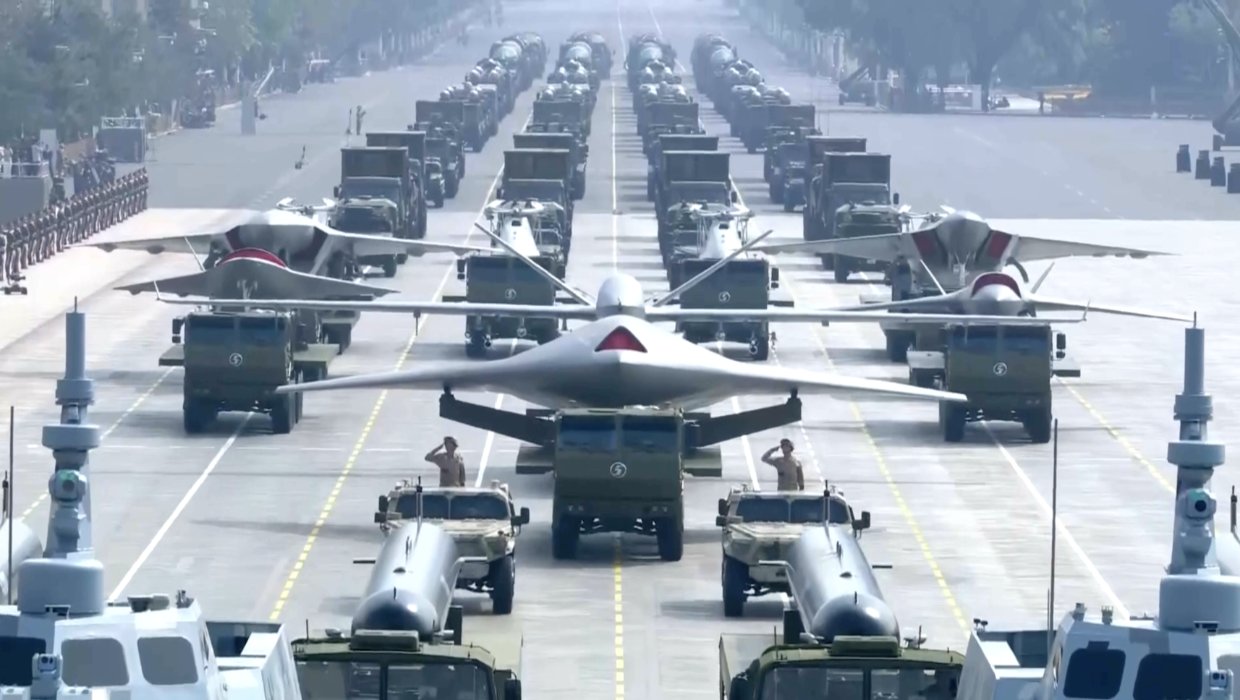
China’s Victory Parade placed a strong emphasis on unmanned and robotic systems, signaling how warfare is shifting from traditional platforms to AI-driven, autonomous technologies. These drones and robotic vehicles provide surveillance, strike capability, and even psychological warfare advantages.
AJX-002 Extra-Large Unmanned Undersea Vehicle (XLUUV)
The AJX-002 is one of the most mysterious and advanced systems revealed during the parade. This extra-large unmanned undersea vehicle (XLUUV) is designed to operate independently beneath the ocean surface.
- Size & Design: Over 18 meters long, giving it the profile of a small submarine.
- Role: Likely used for reconnaissance, surveillance, and electronic intelligence gathering. Its large size also suggests the ability to carry mines or torpedoes.
- Stealth: The absence of a crew allows for extended missions with low acoustic signature, making detection by sonar difficult.
- Comparison: Similar to the US Navy’s Orca XLUUV, indicating a global arms race in autonomous underwater warfare.
This platform could act as a force multiplier for China’s submarine fleet, scouting ahead of manned vessels or laying mines in contested waters.
HSU-100 Unmanned Underwater Drone
Smaller than the AJX-002, the HSU-100 is designed for tactical use in near-shore and littoral environments.
- Mission Profile: Primarily reconnaissance, mine-laying, and anti-submarine warfare support.
- Size & Specs: Around 6–8 meters long, with modular payload bays.
- Capabilities: Can relay sonar mapping data, track enemy submarines, and potentially deploy small explosive charges.
Its main value lies in mass deployment—many of these drones could saturate contested areas, overwhelming traditional anti-submarine defenses.
Surface Unmanned Vessels (USVs)
The parade showcased several surface drones, sometimes described as “optionally crewed” vessels.
- Design: Small, fast boats fitted with radar, cameras, and weapon mounts.
- Roles:
- Mine warfare – placing or clearing naval mines
- Patrol operations – securing harbors or coastlines
- Kamikaze strikes – operating like maritime suicide drones to ram enemy ships
- Autonomy: Equipped with AI navigation, these USVs can swarm targets, similar to drone tactics used in aerial combat.
These systems add flexibility to China’s naval doctrine, especially in the South China Sea, where small, fast-moving vessels are effective in shallow waters.
FH-97 Stealth Drone (Loyal Wingman)
Perhaps the most futuristic aerial drone unveiled was the FH-97, also known as the “loyal wingman.”
- Design: A stealthy, single-engine UAV resembling the American XQ-58A Valkyrie.
- Role: Operates alongside manned aircraft like the J-20 or J-35, carrying out:
- Electronic warfare
- Reconnaissance
- Strike missions
- Decoy operations
- Weapons: Internal bay capable of carrying precision-guided bombs, air-to-air, and air-to-surface missiles.
- Autonomy: Semi-autonomous AI allows coordination with human pilots, reducing workload.
The FH-97 is a game-changer—multiplying the effectiveness of stealth fighters while keeping pilots out of harm’s way.
Robotic Wolves
Among the most eye-catching systems were quadrupedal robots, nicknamed “robotic wolves.”
- Design: Four-legged robots resembling robotic dogs, equipped with cameras, sensors, and in some cases, small weapons.
- Roles:
- Reconnaissance – scouting urban areas or tunnels where humans are at risk
- Target acquisition – marking targets for artillery or drone strikes
- Psychological warfare – intimidating enemies with autonomous swarming tactics
- Capabilities: AI-driven navigation, swarm operation, and ability to function in rugged terrain.
While not yet combat-decisive, these robotic wolves hint at the future of land warfare, where manned units are supported by robotic teammates.
Missiles and Strategic Deterrents
China’s missile arsenal was the centerpiece of the parade, emphasizing its commitment to a credible nuclear triad (land, sea, and air-based nuclear weapons) and advanced hypersonic strike capability.
Intercontinental Ballistic Missiles (ICBMs)
DF-61 ICBM
- Range: Over 12,000 km, making it capable of striking anywhere in the United States.
- Mobility: Road-mobile, mounted on an 11-axle transporter erector launcher (TEL).
- Warheads: Multiple independently targetable reentry vehicles (MIRVs) with nuclear payloads.
- Purpose: Ensures second-strike capability, even if China’s fixed silos are destroyed.
DF-31BJ ICBM
- Range: Around 11,000 km.
- Design: A silo-based ICBM, enhancing survivability with hardened bunkers.
- Payload: 1–3 nuclear warheads.
DF-5C ICBM
- Range: Around 20,000 km, giving it one of the longest ranges of any ICBM worldwide.
- Fuel: Liquid-fueled, requiring longer preparation.
- Warheads: Up to 10–12 MIRVs.
- Significance: Massive deterrent weapon designed to overwhelm missile defense systems.
Together, these ICBMs highlight China’s strategic nuclear deterrence—a guarantee that it can retaliate against any adversary.
JL-1 and JL-3 Submarine-Launched Missiles
JL-1 (Air-Launched Nuclear Missile)
- Carried by modified bombers or surface launch platforms.
- Designed as the air leg of the nuclear triad, ensuring a flexible launch platform beyond silos and submarines.
JL-3 (Submarine-Launched ICBM)
- Range: Estimated over 10,000 km.
- Platform: Deployed on Type 096 nuclear ballistic missile submarines.
- Capability: Can carry multiple nuclear warheads, targeting the US and Europe directly from Chinese waters.
The JL-3 cements China’s sea-based deterrence, ensuring its submarines can conduct stealthy nuclear patrols.
Hypersonic Anti-Ship Missiles (YJ Series)
YJ-15, YJ-17, YJ-19, YJ-20
- Speeds: Capable of reaching Mach 5+, making interception nearly impossible.
- YJ-19: Features scramjet propulsion, enabling sustained hypersonic flight.
- Targets: Designed to destroy aircraft carriers, destroyers, and large naval formations.
- Range: Between 800–2,000 km, depending on variant.
Hypersonic weapons are a nightmare for modern navies. Even the most advanced missile defense systems (like Aegis or THAAD) struggle against hypersonic speeds combined with unpredictable flight paths.
Read more: Pakistan includes J-10C to Air Force to counter India’s Rafale Jets
DF-26D “Guam Killer”
The DF-26D is an intermediate-range ballistic missile (IRBM) specifically designed to threaten US bases in the Pacific.
- Range: Approximately 4,000–5,000 km—easily reaching Guam, a major US military hub.
- Payload: Can carry conventional or nuclear warheads.
- Flexibility: Capable of anti-ship missions, giving it the rare ability to strike moving aircraft carriers.
Nicknamed the “Guam Killer,” this missile reflects China’s intent to neutralize US power projection in the Pacific region.
Directed Energy and Space Defense Systems
China’s military parade revealed more than conventional hardware—it emphasized Beijing’s ambition to dominate the future battlefield, including the realms of directed energy weapons, anti-satellite technology, and integrated air defense systems. These capabilities reflect a broader strategy: controlling not only the land, sea, and air, but also space and cyberspace.
LY-1 Laser Weapon System
The LY-1 represents China’s leap into the age of directed-energy weapons. Initially believed to be developed for the navy, the system was showcased on a land-based vehicle platform during the parade.
- Design: Mounted on a wheeled chassis, the LY-1 carries a turreted laser emitter capable of targeting drones, missiles, and low-flying aircraft.
- Power Output: While exact figures are classified, analysts estimate its energy output exceeds 50–100 kW, enough to burn through UAVs and disable optical sensors.
- Advantages over Missiles:
- Speed-of-light engagement – instant response with no time lag.
- Low cost-per-shot – unlike missiles, which cost hundreds of thousands of dollars, laser “ammo” is effectively unlimited as long as the system has power.
- Silent and precise – minimizes collateral damage.
- Role: Designed for point defense, especially against saturation drone attacks and short-range missiles.
The LY-1 positions China among a handful of countries (including the US and Israel) developing operational laser systems, signaling how energy weapons may soon become standard in layered air defense networks.
HQ-29 Anti-Satellite Missile
Space warfare is no longer science fiction, and China’s HQ-29 system confirms this reality.
- Role: An anti-satellite (ASAT) interceptor, designed to destroy enemy satellites in low Earth orbit (LEO).
- Launch Platform: Ground-based missile system, mobile for survivability.
- Range & Altitude: Capable of striking satellites at altitudes up to 600–1,000 km.
- Significance: By neutralizing satellites, China could cripple enemy navigation, communication, and surveillance networks in wartime.
The HQ-29 is particularly alarming to adversaries, since modern militaries rely heavily on satellites for GPS, intelligence, missile guidance, and secure communications.
HQ-20 Air Defense System
The HQ-20 is China’s newest surface-to-air missile (SAM) system, designed as a mid-tier defense solution.
- Design Heritage: Based on lessons learned from the HQ-9 system (itself modeled after the Russian S-300 series).
- Launcher: Features a larger missile canister with increased capacity per unit, allowing more interceptors to be launched simultaneously.
- Capabilities:
- Intercepts aircraft, cruise missiles, and UAVs at ranges up to 200 km.
- Networked with ground-based radar and AWACS aircraft like the KJ-600.
- Comparison: While not as advanced as the S-400 or US Patriot PAC-3, the HQ-20 strengthens China’s layered air defense shield, particularly against saturation strikes.
Together, the LY-1, HQ-29, and HQ-20 demonstrate China’s strategy of building multi-layered, multi-domain defense, where lasers, SAMs, and anti-satellite systems overlap to protect critical assets.
Radar and Early Warning Systems
The backbone of any modern military is not only its weapons, but also its ability to detect, track, and respond to threats. China emphasized this during the parade by displaying advanced airborne and ground-based radar platforms.
KJ-600 AWACS
Already discussed under aerial platforms, the KJ-600 deserves further attention for its critical role in early warning and battle management.
- Design: Twin-prop aircraft with a rotating radar dome, optimized for aircraft carrier operations.
- Detection Range: Estimated up to 1,200 km, enabling it to track stealth aircraft, cruise missiles, and naval vessels.
- Battle Management: Provides real-time situational awareness to carrier groups, guiding J-15s, J-35s, and even drones into combat.
- Comparison: Functionally similar to the American E-2D Hawkeye, giving China its first true carrier-based AWACS capability.
This system fills a critical gap, extending the PLA Navy’s ability to control the airspace far beyond visual range.
Read more: Pakistan Air Force hits Multiple Indian Rafale jets using Chinese Jets
Ground-Based Radar Units
China also paraded several large, truck-mounted ground-based radar systems. These complement airborne assets by creating a comprehensive surveillance network.
- Design: Large rectangular phased-array panels mounted on mobile trucks.
- Capabilities:
- Detect stealth aircraft at extended ranges.
- Track ballistic missiles during boost and midcourse phases.
- Provide fire-control data for HQ-20 and HQ-29 interceptors.
- Network Integration: These radars feed into China’s integrated air defense system (IADS), linking aircraft, missiles, and command centers.
Ground-based radars are crucial for China’s strategy of A2/AD (Anti-Access/Area Denial), particularly in the South China Sea and Taiwan Strait, where early detection of US or allied forces could mean the difference between defense and defeat.
Strategic Significance of These Systems
The systems displayed in this section—lasers, anti-satellite weapons, SAMs, and radar—reveal three key aspects of China’s strategy:
- Dominating New Domains: By fielding ASAT weapons and lasers, China aims to secure space and near-space environments before adversaries can.
- Layered Defense: From ground-based radars to AWACS aircraft, China is building a deep defense network, capable of detecting and intercepting threats at multiple ranges.
- Technological Parity: The presence of systems similar to US and Russian counterparts (like E-2 Hawkeye, Patriot PAC-3, and naval lasers) highlights China’s determination to match and surpass rivals technologically.
Conclusion
China’s Victory Day Parade was far more than a ceremonial event—it was a strategic display of power and technological advancement. By showcasing everything from heavy tanks and stealth jets to underwater drones, hypersonic missiles, and even robotic wolves, Beijing sent a clear signal to the world: the People’s Liberation Army (PLA) is no longer a regional force, but a globally competitive military power.
What makes this display significant is the balance between conventional firepower and futuristic systems. On the one hand, China continues to rely on proven platforms such as the Type 99A tank, J-20 stealth fighter, and H-6 bomber. On the other, it is pushing into new realms with hypersonic strike weapons, AI-powered drones, directed-energy lasers, and anti-satellite missiles. This combination provides flexibility, resilience, and deterrence against even the most technologically advanced adversaries.
The equipment displayed also underscores China’s nuclear triad, with land-based ICBMs, sea-launched JL-3 missiles, and air-launched nuclear systems ensuring a credible second-strike capability. In addition, the emphasis on A2/AD (Anti-Access/Area Denial)—through systems like the DF-26D “Guam Killer,” YJ-series hypersonics, and HQ-20 air defense—reflects China’s determination to secure its near seas while challenging US dominance in the Indo-Pacific.
Equally important is the shift toward automation and autonomy. The inclusion of unmanned underwater drones, stealthy loyal wingman UAVs, and robotic quadrupeds highlights how warfare is moving beyond traditional human-centric combat. These platforms expand battlefield awareness, reduce risks to human soldiers, and create new dimensions of combat that adversaries must adapt to.
Ultimately, the Victory Parade was a message of deterrence and ambition. It demonstrated that China is prepared not only to defend its sovereignty but also to assert its influence on the global stage. By combining advanced missiles, cutting-edge aircraft, laser weapons, and space defense systems, Beijing has crafted a toolkit that could reshape the balance of power in the 21st century.
About the Author