Pakistan Driverless Car
NED University engineers have develped Pakistan first driverless car — a real, road-tested, AI-powered autonomous car. Here’s the full story.
Imagine sitting in a car with no one behind the wheel. No driver. No hand on the steering. No foot nervously hovering over the brake. Just a machine quietly reading the road ahead, making split-second decisions, and confidently navigating the streets — completely on its own.
That’s not science fiction. That’s not something imported from Silicon Valley or Stuttgart. That actually happened in December 2025, on the campus of NED University right here in Karachi.
Read More: Tezmo launched Made in Pakistan Electric Rickshaw
The Team That Made It Happen
A group of engineers at NED University of Engineering and Technology pulled off something historic. They built, tested, and successfully drove Pakistan’s very first AI-powered driverless car — and when it rolled smoothly across the campus road without a single human touch on the controls, the crowd watching couldn’t believe their eyes.
The project was led by the National Centre for Artificial Intelligence, known as NCAI, which operates within NED’s Department of Computer and Information Sciences. The federal government set up nine AI research centres across Pakistan to push the boundaries of local innovation, and NED’s NCAI is one of them.
At the helm of the project was Dr. Muhammad Khurram, NCAI’s Director and an Associate Professor at the university. He and his team spent nearly a year turning an ambitious idea into a moving, thinking, road-navigating reality.
So How Did They Actually Build It?
They didn’t start from zero. Instead of designing a car from scratch, the team made a smarter choice — they took an electric vehicle imported from China and completely reimagined what it could do.
The car kept its original body and wheels. But everything that makes it think, react, and drive was built entirely by Pakistani engineers. It was essentially a brain transplant — out with the human driver, in with a powerful network of artificial intelligence and cutting-edge sensors.
Here’s what the car is now packed with:
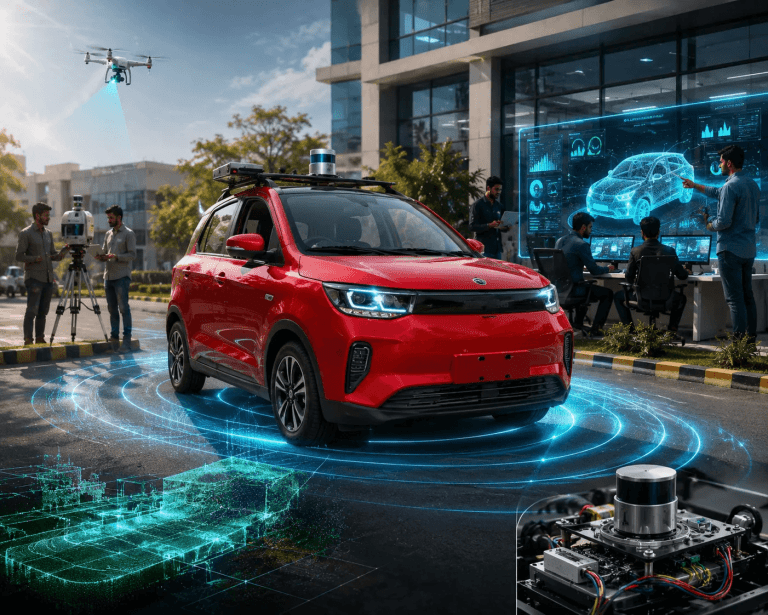
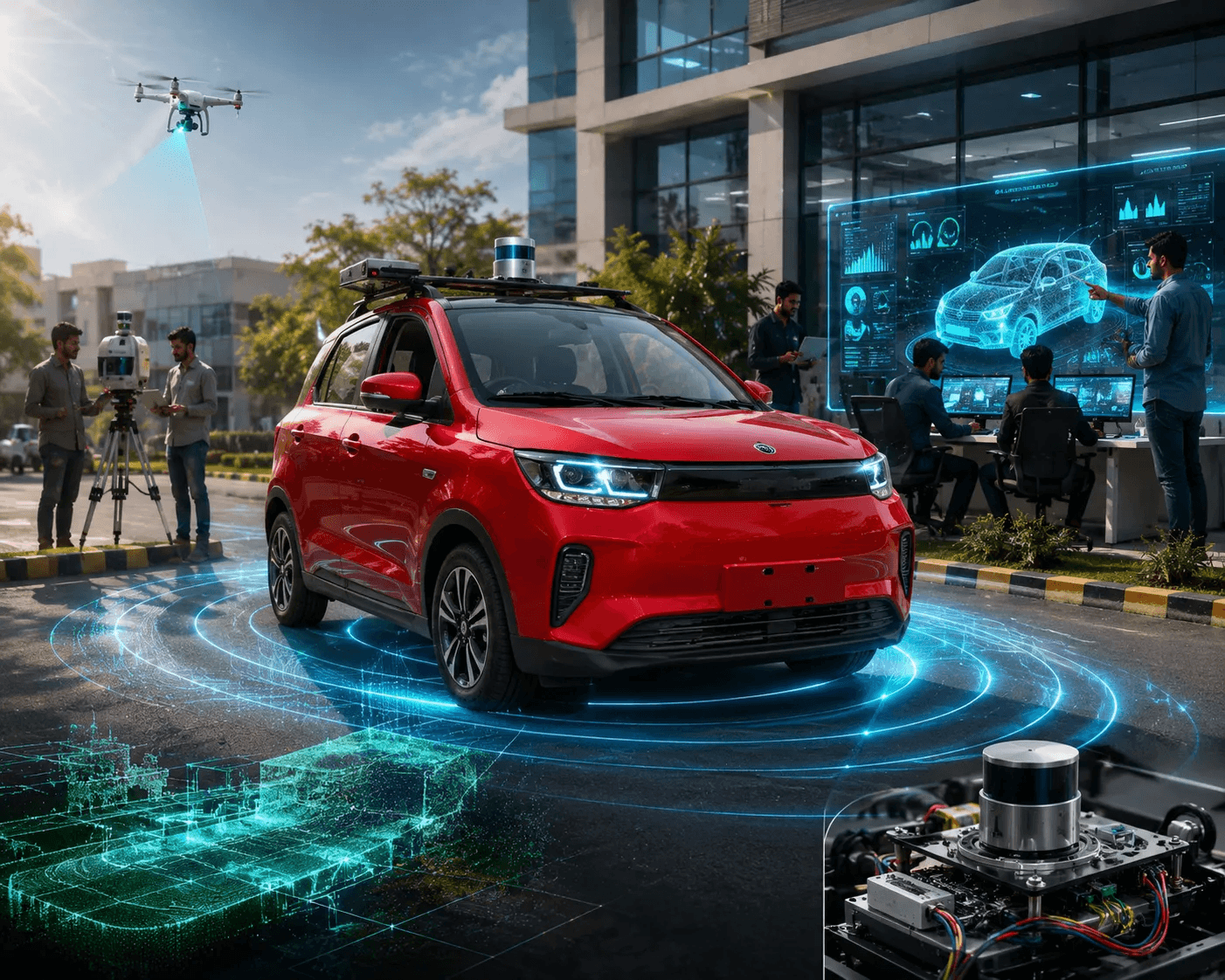
LiDAR technology fires thousands of laser pulses every second to build a live, three-dimensional picture of everything around the vehicle — other cars, pedestrians, walls, kerbs, everything.
Radar sensors keep track of moving objects and calculate distances accurately, even when visibility is poor — at night, in fog, or in dusty conditions.
Computer vision cameras scan the road continuously, reading lane markings, spotting traffic signals, identifying potholes, and flagging obstacles before the car gets anywhere near them.
AI algorithms tie all of this together. They process the flood of incoming data and decide, in real time, exactly what the car should do next — slow down, steer left, stop, or keep going.
It is, in every sense, a car that thinks for itself.
The Real Test: Pakistani Roads
Here is where the story gets genuinely impressive.
Building a self-driving car for a smooth, well-lit German motorway with clear lane markings and predictable traffic is a challenge in itself. Building one for Pakistani roads is something else entirely.
Karachi’s streets are a world of their own. Rickshaws dart between lanes without warning. Motorcycles appear from every direction. Speed bumps show up with no signage. Lane discipline is more of a suggestion than a rule. Pedestrians cross wherever they please. And potholes — well, potholes are practically a local landmark.
The NED team didn’t shy away from this reality. They built their car specifically to handle it. One of the engineers on the project, Inzamam Khan, put it plainly — their sensor system is strong enough to read uneven surfaces, navigate local road infrastructure, and stay safe even when conditions are completely unpredictable. He noted that very few autonomous vehicles anywhere in the world are being tested in urban environments as challenging as Karachi’s.
That context makes what NED has achieved all the more remarkable.
Where the Car Stands Today
The team is honest about where development currently sits. This is not a finished product ready for commercial roads. It is a working prototype that is getting smarter with every test run.
Right now, the car travels at a controlled speed of 15 to 20 kilometres per hour. It can steer, turn, judge oncoming traffic, recognise traffic signals, detect lanes, and respond to objects in its path. Every road trial generates fresh data, and that data feeds back into the AI, making the system a little sharper and a little more capable each time.
Continuous testing is underway, and the engineers are working to expand the car’s capabilities steadily and safely.
Why This Matters Far Beyond a University Campus
This project is bigger than one institution. It is a signal to the world — and to Pakistan itself — that local engineers can take on global-level problems and deliver real results.
Autonomous vehicles are set to transform transportation over the next two decades. Fewer road accidents. Smarter traffic flow. More efficient movement of people and goods. Countries that develop expertise in this technology now will have a significant advantage in shaping what transport looks like in the future.
For Pakistan, where road accidents tragically claim tens of thousands of lives every year, the safety case for autonomous vehicle technology is not abstract. It is urgent. Every improvement in how cars sense, react, and avoid danger has the potential to save real lives on real roads.
The fact that Pakistani engineers are already solving these problems — using local knowledge to tackle the unique chaos of Pakistani streets — puts this country in a position it has rarely occupied before: ahead of the curve.
What Comes Next
The NED team has proven the concept works. The road ahead involves expanding test routes beyond the university campus, gradually increasing speeds, and continuing to refine the AI’s ability to handle the full, unpredictable complexity of urban Pakistani traffic.
It will take time. It will take more testing, more data, and more iteration. But the hardest part — proving it can be done — is already behind them.
Pakistan’s first driverless car has taken its first drive. What began as a research project in a Karachi university lab is now a moving, navigating, decision-making machine on real roads. The journey from here to a smarter, safer Pakistan is well and truly underway.
About the Author