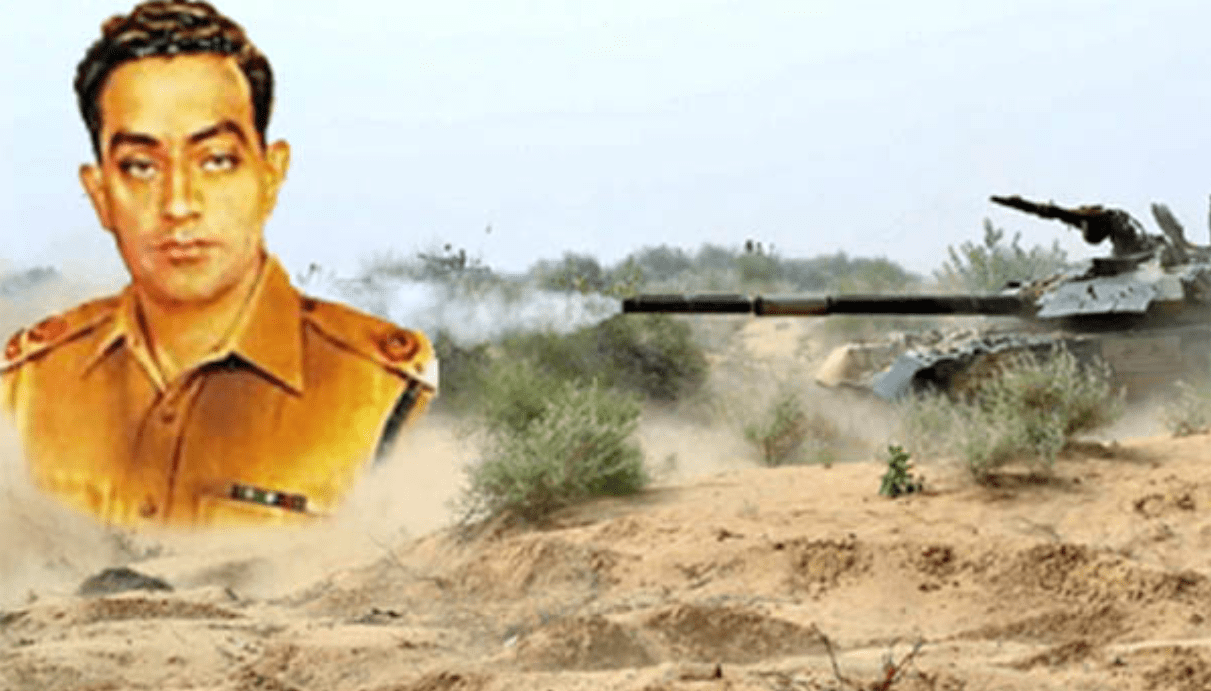
Major Raja Aziz Bhatti
Major Raja Aziz Bhatti stands among Pakistan’s most revered soldiers. Awarded the Nishan-e-Haider—the country’s highest military decoration for valor—he became a symbol of steadfast leadership and selfless courage during the 1965 war. His choices under fire, especially around the BRB Canal east of Lahore, have entered the canon of military case studies on small-unit defense, morale, and mission focus.
Early Life and Formation of Character
Raja Aziz Bhatti was born in 1928 in British Hong Kong to a Punjabi family originally from Ladian village in the Gujrat District. The family moved to Pakistan after Partition in 1947. Those who later served with him often linked his calm demeanor and quiet confidence to a childhood shaped by displacement and responsibility—traits that would define his conduct as an officer.
Also Read: Paksitan Air Force’s only Nishan-e-Haider Rashid Minhas
Drawn to the profession of arms as the new state built its institutions, Bhatti entered the Pakistan Military Academy at Kakul. He graduated with distinction and is widely remembered for earning the coveted Sword of Honour and the Norman Gold Medal, awards reserved for the most outstanding cadet in training. Commissioned into the Punjab Regiment, he began a career that mixed field command with periods as an instructor, where his attention to discipline and fieldcraft earned respect from peers and subordinates alike.
The Strategic Setting: 1965 and the Defence of Lahore
The Indo-Pak war of 1965 opened on multiple fronts. East of Lahore, the defensive line was anchored on the Bambanwala-Ravi-Bedian (BRB) Canal—a man-made water obstacle designed to slow and canalize any enemy advance. The terrain around the canal is flat and crisscrossed by irrigation channels, with small villages—Bedian and Barki, in particular—dominating crossing sites and road approaches. If the enemy forced a crossing there, Lahore could be threatened.
Major Bhatti was a company commander in 17 Punjab Regiment when hostilities expanded in early September. His company was tasked with holding a critical sector along the BRB Canal near Barki. The assignment demanded not just firepower but also tactical patience: delay and disorganize the attacker, hold the canal line, and prevent any breakout toward the city.
The Crucible: Six Days at the BRB Canal
From approximately 6 to 10 September 1965, Major Bhatti led from the front in a fight that alternated between artillery duels, probing infantry attacks, and localized counter-assaults. Several elements of his leadership during these days stand out:
1) Refusing relief under fire.
As pressure mounted, superiors reportedly offered to relieve him from the forward observation position he had taken to better direct artillery fire. He declined. In his judgment, continuity of command and firsthand observation were decisive. By staying exposed, he preserved both accuracy and tempo in the defensive fires that broke repeated thrusts toward the canal.
2) Orchestrating combined arms effects.
Though commanding an infantry company, he fought as an integrator—linking infantry, mortars, and supporting artillery. Accurate, timely fire missions disrupted enemy forming-up points and crossing attempts. His insistence on staying where he could see the ground meant he could adjust rounds rapidly as attacks developed.
3) Steadying the line.
Accounts from comrades describe him moving along trenches and weapon pits, checking arcs of fire, redistributing ammunition, and encouraging soldiers who had been without sleep for days. In small-unit actions, morale is a combat multiplier; his presence in the most dangerous places communicated calm confidence.
4) Tactical economy.
He practiced “economy of force” with ammunition and manpower. Fire was disciplined and purposeful, saved for moments that mattered—likely one reason the company could sustain the defense through multiple cycles of attack.
By 9–10 September, fighting centered around Barki village and the approaches to the canal. Enemy forces increased their use of armor and direct-fire weapons to neutralize Pakistani positions influencing the crossing points. The battle became a contest of observation and survivability: whoever saw first and corrected fire faster would shape the outcome.
Also Read: Pakistan Air Force ranks
The Final Act: Courage in the Open
On 10 September 1965, Major Bhatti moved again to an exposed location to continue directing artillery against advancing forces threatening the line. From that vantage, he had the best view and could relay corrections with seconds to spare—but it also made him a target. During one of these fire missions, he was struck and killed by a tank shell.
He had remained forward for nearly six days and nights, repeatedly refusing to step back from the danger because he judged that his presence at the point of decision was essential. His death was instantaneous; the effects of his leadership, however, persisted. The defense held. The canal line in his sector did not break.
Why His Actions Mattered—Beyond Heroism
It is tempting to frame Major Bhatti’s conduct solely as personal bravery. It was much more than that—it was decisive leadership under mission command. Several military lessons emerge from his example:
- Mission clarity beats comfort. He accepted personal risk in exchange for better information and command agility—key advantages in a fluid fight.
- Forward leadership compresses the kill chain. By observing and correcting artillery from the front, he reduced the sensor-to-shooter time that often decides engagements.
- Morale and discipline are combat power. His presence stabilized soldiers under continuous fire, preserving unit cohesion when it mattered most.
- Defense as an active fight. He treated the defense not as static endurance but as a series of offensive actions—reconnaissance, interdiction, and rapid shifts of fire.
These are enduring principles in small-unit tactics and combined arms operations, and they explain why his actions are still studied.
Nishan-e-Haider: The Highest Honour
In recognition of his conspicuous gallantry, leadership, and supreme sacrifice, Pakistan posthumously awarded Major Raja Aziz Bhatti the Nishan-e-Haider. The decoration is reserved for acts of extraordinary valor in the face of the enemy, and only a handful of Pakistan’s soldiers have received it. His citation—often quoted in military circles—highlights his refusal to be relieved, his unbroken presence at the front, and his relentless direction of fire that blunted attacks on Lahore’s approaches.
Read More: PAF Chief who changed the culture of Pakistan Air Force
Memory, Memorials, and a Living Legacy
Major Bhatti’s legacy lives in multiple forms:
- Regimental memory. Within the Punjab Regiment, his story is passed to new generations as a model of what “duty before self” looks like in the field.
- Military education. His defense of the BRB Canal is used in staff rides and classroom discussions on defensive operations, leadership under stress, and the employment of observation posts in modern battle.
- National remembrance. Streets, institutions, and monuments bear his name. Each September, public ceremonies and media retrospectives recall his stand near Barki as emblematic of national resolve.
- Civic lessons. Outside the military, he is remembered as proof that effectiveness and integrity can coexist—that responsibility, once accepted, must be carried to conclusion.
The Man Behind the Medal
Those who knew Major Bhatti remembered him as courteous and measured, a professional who neither dramatized danger nor minimized responsibility. He valued preparation—range cards drawn carefully, fields of fire rehearsed, fallback positions marked—and he trusted soldiers to deliver when equipped with clear purpose. His heroism was not a sudden flourish but the culmination of habits formed over years: study, discipline, and empathy for the men he led.
Why His Story Endures
Countries need stories that teach as well as inspire. Major Raja Aziz Bhatti’s life does both. His choice to remain exposed to direct accurate fire; his ability to coordinate across arms; his refusal to abandon a position whose loss might imperil a city—these are concrete actions with tactical effect, not abstractions. They show how one officer, at the right place and time, can shift the balance of a larger battle.
In the end, his courage was not just the willingness to face danger—it was the professional judgment to stay where he knew he was most needed, and to keep fighting until the line held. That, more than any medal, is why his name continues to carry weight in Pakistan’s military history and collective memory.
About the Author