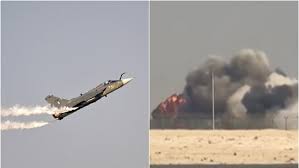
tejas crashes
A tragic accident unfolded at the Dubai Air Show on November 21, 2025, when an Indian Air Force (IAF) HAL Fighter Jet Tejas crashes during a high-speed aerobatic demonstration. The mishap resulted in the death of the pilot, casting a shadow over one of the world’s biggest aviation exhibitions and raising fresh questions about the Tejas program’s safety and reliability.
Read More: Multiple Indian Air Force fighter jets crashes
How the Tejas Crash Happened
Thousands of spectators had gathered at the outdoor viewing area of Al Maktoum International Airport when the Tejas began its scheduled display routine. According to eyewitnesses, the Tejas aircraft transitioned from a climbing maneuver into what appeared to be a steep descending roll. Infront of the cameras within split seconds the Tejas crashes. Moments later, it suddenly lost altitude, plunged toward the runway, and struck the ground with tremendous force.
The impact produced a massive fireball that sent thick black smoke billowing into the sky. The violent explosion visibly rattled spectators; many were seen running for safety, while air-show officials rushed to secure the perimeter. Emergency crews arrived almost immediately, but despite their rapid response, the pilot could not be saved.
The Indian Air Force later confirmed the pilot’s death and ordered a court of inquiry to determine the exact cause of the accident.
What Is the HAL Tejas?
The HAL Tejas is India’s indigenous Light Combat Aircraft, developed to replace aging Soviet-era jets and strengthen the IAF’s fleet with a modern, multirole platform. The aircraft that crashed in Dubai was part of the IAF’s demonstration team, showcasing India’s domestic aerospace capabilities on an international stage.
This particular variant is believed to be a Tejas Mk-1, the version currently in operational service. India plans to induct larger numbers of the improved Mk-1A, which features upgraded avionics, radar, and electronic warfare capabilities.
Social Media Fuel-Leak Videos: What Happened Before the Crash
In the days leading up to the incident, several short clips went viral on social media showing a Tejas on the ground with liquid dripping from its underside. Many users claimed the jet was leaking fuel or hydraulic fluid and questioned whether the aircraft was mechanically fit for air-show flying.
Indian authorities quickly dismissed these claims, stating that the liquid seen was condensed water, which routinely drains from systems like the Environmental Control System (ECS) and the onboard oxygen generator — especially in hot, humid climates like Dubai. Officials labeled the leak videos as “misleading” and warned against spreading unverified information.
It remains unknown whether the aircraft in the viral clips was the same jet that later crashed, and no official link has been established between those videos and the accident.
Other Recent Crashes Involving Tejas and Indian Fighter Jets
Although the Tejas has generally maintained a solid safety record, this is not the first incident involving the aircraft:
1. Tejas Crash in Jaisalmer (March 2024)
A Tejas Mk-1 crashed during a military exercise in Rajasthan. The pilot ejected safely. Investigators later traced the cause to an engine-related failure, reportedly involving an oil-pump malfunction that led to loss of power.
2. Fighter Jet Losses During 2025 Border Clashes
India experienced several fighter aircraft losses during the brief but intense cross-border confrontations in May 2025. Though details remain sensitive, analysts have confirmed multiple aircraft, including older models like the MiG-21 and MiG-29, were lost in combat operations.
3. IAF’s Broader Accident History
The Indian Air Force has been phasing out legacy jets with historically high accident rates. The goal is to replace them with newer, safer platforms like the Tejas — which makes each new incident involving the indigenous fighter particularly significant.
Why This Accident Matters
The Dubai crash is especially consequential for several reasons:
A Global Stage
The Dubai Air Show is one of the most high-visibility aviation events in the world. Any accident, especially involving a modern fighter jet, inevitably draws international attention and scrutiny.
Impact on India’s Defense Export Plans
India has actively promoted the Tejas for export, pitching it to friendly nations as a light, cost-effective fighter. A public crash could complicate ongoing discussions and affect international confidence in the aircraft.
Operational Questions for the IAF
As India increases its dependence on the Tejas to replace older aircraft, safety concerns may influence training protocols, maintenance standards, and production oversight.
Emotional Toll
The death of a pilot — a highly trained and valued officer — leaves a deep impact on the air force community and the nation. Air-show display flying is particularly demanding, and such losses are felt intensely.
What Investigators Will Likely Examine
The IAF’s court of inquiry will study multiple aspects of the crash, including:
- Mechanical performance: Engine reliability, hydraulic systems, flight controls, and any pre-flight technical anomalies.
- Pilot factors: Training history, health, situational workload, decision-making during the maneuver.
- Maneuver profile: Whether the pilot initiated a high-risk maneuver at too low an altitude or whether recovery options were limited.
- Environmental conditions: Wind patterns, heat, density altitude, and potential bird activity.
- Maintenance records: Any recent repairs, part replacements, or repeated defects on the specific airframe.
- Human factors and safety procedures: Briefings, display-routine approvals, and risk assessments.
It may take weeks or even months for investigators to analyze the debris, review maintenance logs, study flight data, and compile a full report.
Conclusion
The crash of the Tejas fighter jet at the Dubai Air Show is a somber reminder of the inherent risks of military aviation — especially during complex aerobatic displays. While speculation continues online, the true cause of the accident will only be known after a thorough investigation.
For India, this incident is emotionally and strategically significant: a pilot lost his life, a flagship indigenous aircraft suffered a high-profile failure, and the world was watching. The findings of the inquiry will not only determine what went wrong but may also shape the future direction of the Tejas program and India’s aerospace ambitions.
About the Author


