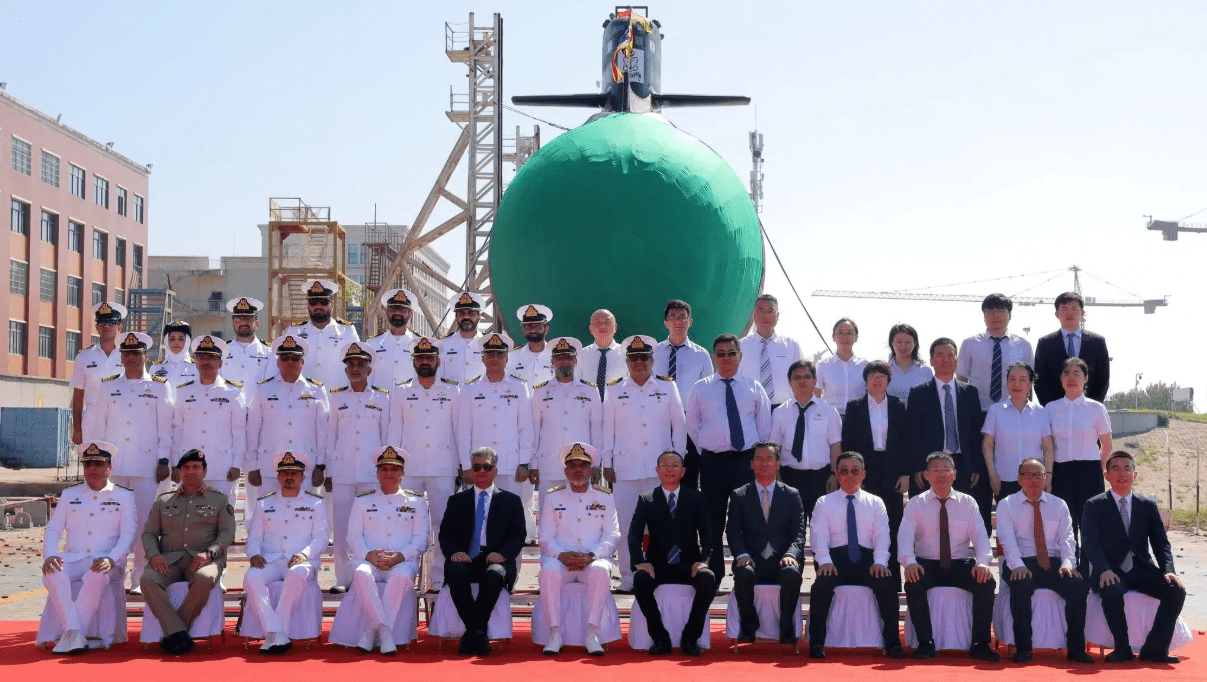
Hangor Submarine
The Pakistan Navy’s third Hangor-class submarine, designated PNS/M MANGRO, was formally launched at Wuchang Shipbuilding Industry Group Company Ltd, Shuangliu Base, Wuhan, China. The event was attended by senior Pakistani and Chinese naval officials, with Vice Admiral Abdul Samad, Deputy Chief of Naval Staff (Projects-2), serving as the chief guest.
In his remarks, the Chief Guest emphasized the growing significance of maritime security in the Indian Ocean Region (IOR), stressing that the induction of advanced Hangor-class submarines will be critical in maintaining a regional power balance while safeguarding Pakistan’s maritime frontiers. He commended the continued cooperation between Pakistan and China, highlighting that the Hangor program symbolizes not only naval modernization but also the enduring strategic partnership between the two nations.
Read more: Ranks in Pakistan Navy
The Hangor-Class Program
Pakistan signed an agreement with China Shipbuilding & Offshore International Company Ltd (CSOC) in 2015 to acquire eight Hangor-class submarines, an export variant of the Type 039B Yuan-class operated by the People’s Liberation Army Navy (PLAN).
According to the deal:
- Four submarines are being constructed in China.
- Four submarines will be built in Pakistan at the Karachi Shipyard & Engineering Works Ltd (KS&EW) under a Transfer of Technology (ToT) program.
The first Hangor submarine was launched in 2024, with deliveries planned through 2028. This marks the largest-ever naval acquisition in Pakistan’s history, aimed at modernizing its underwater warfare fleet.
Technical Specifications & Capabilities
While exact specifications of the Hangor-class remain classified, available insights suggest:
- Length & Displacement: Approximately 76 meters in length with a displacement of 2,800 tons, slightly heavier than the baseline Chinese S26 design.
- Propulsion: Likely to incorporate an Air-Independent Propulsion (AIP) system, extending underwater endurance compared to conventional diesel-electric submarines. This would allow the Hangor-class to remain submerged for two to three weeks, reducing detection risks.
- Sensors & Stealth: Advanced sonar suites, electronic warfare systems, and low acoustic signatures make it one of the quietest and most survivable platforms in the region.
- Weapon Systems: While not officially disclosed, experts expect the submarines to be armed with:
- Anti-ship cruise missiles (ASCMs) for sea-denial operations.
- Heavyweight torpedoes against both surface and submarine targets.
- Possible integration of Babur-3 Submarine-Launched Cruise Missile (SLCM), giving Pakistan a credible sea-based nuclear second-strike capability.
Existing Submarine Fleet of Pakistan Navy
The Pakistan Navy already maintains an effective undersea force, which will be greatly reinforced once the Hangor-class is fully inducted. Current assets include:
- Agosta 90B Khalid-class (with AIP)
- Submarines: PNS Khalid, PNS Saad, PNS Hamza
- These are modern French-origin diesel-electric submarines with Air-Independent Propulsion, enabling long submerged endurance.
- They are undergoing mid-life upgrades through Turkey’s STM company, with modernized sonar suites, fire control systems, periscopes, and electronic warfare systems.
- Agosta 70-class (older generation)
- Submarines: PNS Hashmat, PNS Hurmat
- Acquired from France in the late 1970s, these diesel-electric submarines are still operational but are approaching the end of their service lives.
Once the eight Hangor-class submarines join service, the Pakistan Navy will operate one of the largest submarine fleets in the region, modernizing its undersea warfare capabilities and eventually phasing out the aging Agosta-70 boats.
Read more: Pakistan include Chinese Helicopters to its Air Defence fleet
Strategic Importance for Pakistan Navy
Strengthening A2/AD Capabilities
The Hangor-class will significantly enhance Pakistan’s Anti-Access/Area Denial (A2/AD) posture, making it extremely difficult for hostile naval forces to operate freely in the Arabian Sea.
Sea-Based Deterrence
If armed with Babur-3 SLCMs, the Hangor-class will provide Pakistan with a survivable sea-based nuclear deterrent, ensuring credible second-strike capability.
Countering Indian Naval Expansion
India’s growing naval power—nuclear submarines, aircraft carriers, and advanced frigates—poses a challenge in the region. The Hangor-class gives Pakistan an asymmetric advantage, using stealth and long-range strike capabilities to offset numerical disadvantages.
Modernization of Submarine Fleet
With Agosta 90Bs undergoing upgrades and the induction of eight Hangor-class submarines, Pakistan Navy will achieve a modern, balanced submarine fleet capable of extended operations, surveillance, and strike missions.
Future Plans and Vision
The Hangor-class project is part of a broader naval modernization strategy that looks ahead to the 2030s. Future plans include:
- Expanding local submarine construction through KS&EW for greater self-reliance.
- Integrating unmanned systems such as UAVs and UUVs for reconnaissance and undersea warfare.
- Transitioning from a coastal defense navy to a blue-water navy, capable of projecting power across the Indian Ocean.
- Expanding surface combatants with Type-054A/P frigates and modern fast attack craft.
- Strengthening maritime partnerships, particularly with China and Turkey, for technology transfer and co-development.
Conclusion
The launch of PNS/M MANGRO, the third Hangor-class submarine, is a historic step in Pakistan’s naval journey. With eight such submarines planned, Pakistan will operate one of the most advanced undersea fleets in South Asia, ensuring a credible deterrent and strong maritime defense posture.
By combining stealth, advanced weaponry, and indigenous production under the Transfer of Technology program, the Hangor-class initiative not only boosts Pakistan Navy’s combat power but also symbolizes its long-term vision of becoming a self-reliant and modern maritime force in the Indian Ocean.
About the Author